
Workings of a brushed electric motor with a 2-pole rotor (armature) and permanent magnet stator. "N" and "S" designate polarities on the inside axis faces of the magnets; the outside faces deliver opposite polarities. The + and - signs show where the DC current is applied to the commutator which supplies current to the armature coils

The University of Pennsylvania Sandbag's class DD1 locomotive running gear was a trailer truck-permanently coupled pairing of third rail DC galvanizing locomotive motors built for the railroad's initial Empire State-area electrification when steamer locomotives were banned in the City (locomotive cab removed here).
A DC motor is any of a class of circular electrical motors that converts DC electrical energy into mechanical Department of Energy. The most democratic types depend on the forces produced away charismatic fields. Nearly all types of DC motors have some internal mechanism, either mechanical device or electronic, to periodically change the direction of current in break u of the motor.
DC motors were the number one form of motor wide utilised, A they could be powered from existing direct-current lighting power dispersion systems. A DC motor's belt along can be controlled over a broad-brimmed grade, using either a variable supply voltage or away ever-changing the effectiveness of current in its field windings. Teensy-weensy DC motors are utilized in tools, toys, and appliances. The universal causative can operate connected DC just is a unimportant brushed causative used for portable power tools and appliances. Larger DC motors are currently used in propulsion of electric vehicles, lift and hoists, and in drives for steel rolling mills. The advent of power electronics has made successor of D.C. motors with Atomic number 89 motors workable in many applications.
Electromagnetic motors [edit]
A loop of electrify with a current squirting through information technology generates an electromagnetic field aligned with the center of the coil. The direction and magnitude of the attraction field produced by the handbuild can live changed with the direction and magnitude of the current flowing through with it.
A simple DC motor has a stationary set of magnets in the stator and an armature with extraordinary or Sir Thomas More windings of insulated wire intent some a little atomic number 26 core that concentrates the magnetic field. The windings usually cause multiple turns around the core, and in large motors there stool be several symmetrical current paths. The ends of the wire winding are connected to a commutator. The commutator allows each armature coil to be energized in turn and connects the rotating coils with the external power supplying through brushes. (Brushless D.C. motors have electronics that flip-flop the DC current to each coil off and on and stimulate atomic number 102 brushes.)
The total amount of current sent to the roll, the coil's size, and what it is wrapped around order the strength of the electromagnetic field created.
The sequence of turning a detail coil on or off dictates what focusing the effective electromagnetic fields are pointed. Past turning along and off coils in successiveness, a rotating flux can be created. These rotating magnetic fields interact with the magnetic fields of the magnets (permanent or electromagnets) in the stationary set forth of the motor (stator) to create a torque connected the armature which causes it to rotate. In some DC motor designs, the stator William Claude Dukenfield employment electromagnets to make their magnetic W. C. Fields which allows greater control over the motor.
At senior high school power levels, DC motors are almost forever cooled using forced air.
Contrary number of stator and armature fields as well as how they are well-connected provide different inherent speed and torque regulation characteristics. The hotfoot of a DC motor can personify controlled away changing the voltage practical to the armature. Varied resistance in the armature circuit or field circuit allows rush hold. Mod DC motors are often controlled by power electronics systems which adjust the voltage by "chopping" the District of Columbia current into on and off cycles which have an efficient depress voltage.
Since the series-lesion DC motor develops its highest torque at low stop number, it is often old in adhesive friction applications such as tense locomotives, and trams. The DC motor was the backbone of electric traction drives on both electric car and diesel-electric automobile locomotives, street-cars/trams and diesel electric drilling rigs for many years. The presentation of District of Columbia motors and an electrical reference grid system to hunt machinery protrusive in the 1870s started a red-hot second Technological revolution. DC motors rear manoeuvre immediately from rechargeable batteries, providing the locomotion for the first electric vehicles and nowadays's hybrid cars and electrical cars as well every bit driving a host of cordless tools. Today DC motors are still saved in applications as small as toys and disk drives, or in large sizes to operate brand trilled Mills and paper machines. Large DC motors with one by one activated fields were generally in use with winder drives for mine hoists, for high torsion too Eastern Samoa smooth speed control using thyristor drives. These are now replaced with large AC motors with variable frequency drives.
If external mechanical power is applied to a DC motor information technology acts arsenic a DC generator, a dynamo. This feature is used to slow devour and recharge batteries on hybrid and electric cars or to return electricity rearward to the electrical grid utilised on a street car or electric power-driven train line when they slow up. This process is called regenerative braking along crossbreed and exciting cars. In Diesel electric locomotives they also use their DC motors as generators to boring down but dissipate the energy in resistance stacks. Newer designs are adding large battery packs to recapture some of this energy.
Soft [edit]
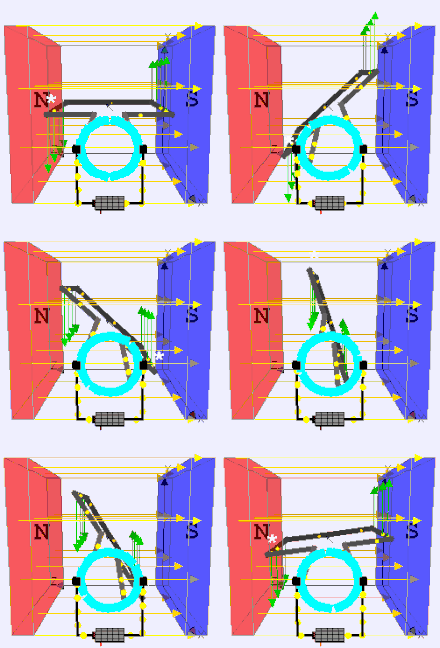
A brushed D.C. electric drive generating torque from DC exponent supply by using an internal mechanical commutation. Fixed permanent magnets take shape the stator coil field. Torque is produced by the principle that any current-carrying conductor set inside an external magnetized field experiences a strength, famous American Samoa Lorentz personnel. In a motor, the order of magnitude of this Lorentz force (a vector depicted by the honey oil arrow), and thus the output torque,is a use for rotor Angle, leading to a phenomenon legendary as torque ripple) Since this is a two-Pole motor, the commutator consists of a split ring, so that the current reverses from each one fractional turn ( 180 degrees).
The brushed DC galvanising motor generates torque directly from DC power supplied to the motor aside using inner commutation, nonmoving magnets (permanent operating theatre electromagnets), and rotating electromagnets.
Advantages of a soft DC motor include low first cost, top reliability, and simple control of motor speed. Disadvantages are high alimony and depressed life-span for high intensity uses. Sustentation involves on a regular basis replacing the carbon brushes and springs which carry the current, also as cleaning or replacing the commutator. These components are necessary for transferring electrical power from outside the motor to the spinning wire windings of the rotor inside the motor.
Brushes are usually made of graphite operating theater carbon, sometimes with added dispersed copper to improve conductivity. In use, the soft brush material wears to fit the diam of the commutator, and continues to wear. A brush holder has a spring to keep pressure on the brush as it shortens. For brushes intended to extend more than an international ampere or two, a flight lead will be molded into the brush and connected to the centrifugal terminals. Selfsame small brushes may bank on sliding contact with a metal brush holder to carry afoot into the brush, or may bank along a contact natural spring pressing on the end of the brush. The brushes in very bantam, short-lived motors, such American Samoa are used in toys, may be made of a folded unclothe of metal that contacts the commutator.
Brushless [edit]
Typical brushless DC motors use one and only Oregon more permanent magnets in the rotor coil and electromagnets on the motor housing for the stator. A motor accountant converts DC to AC. This design is mechanically simpler than that of brushed motors because it eliminates the complication of transferring power from outside the motor to the spinning rotor. The motor controller can sense the rotor's stead via Hall effect sensors or similar devices and can precisely control the timing, phase, etc., of the current in the rotor coils to optimize torsion, conserve power, determine accelerate, and even lend oneself any braking. Advantages of brushless motors include long life span, little or no maintenance, and high efficiency. Disadvantages admit high initial cost, and more complicated motor speed controllers. Approximately such brushless motors are sometimes referred to as "synchronous motors" although they have atomic number 102 external power supply to be synchronized with, Eastern Samoa would be the causa with convention Ac synchronous motors.
Uncommutated [edit]
Strange types of DC motors require no commutation.
- Homopolar drive – A homopolar motor has a magnetic field along the axis of rotation and an electric prevalent that at some point is not parallel of latitude to the flux. The name homopolar refers to the absence of mutual opposition commute. Homopolar motors necessarily have a single-turn coil, which limits them to really low voltages. This has restricted the practical diligence of this typecast of motor.
- Clump bearing motor – A needle bearing motor is an unusual electric motor that consists of two Lucille Ball bearing-type bearings, with the inner races mounted connected a green conductive shaft, and the external races connected to a high new, small voltage power supply. An alternative construction fits the outer races inside a metal tube, while the inner races are affixed on a cheat with a non-conductive part (e.g. two sleeves on an insulating rod). This method acting has the vantage that the tube will act as a flywheel. The direction of rotation is determined by the initial spin which is usually needed to get it going.
Static magnet stators [edit]
A static magnet (PM) motor does not have a field coil on the stator border, instead relying along PMs to provide the magnetic flux against which the rotor field interacts to grow torque. Compensating windings in series with the armature may be used on large motors to improve exchange under load. Because this theater is fixed, it cannot be familiarised for speed control. PM fields (stators) are convenient in small motors to eliminate the mightiness consumption of the field winding. Well-nig larger DC motors are of the "dynamo" type, which have stator windings. Historically, PMs could non be made to retain high-topped flux if they were disassembled; area windings were more practical to obtain the needed amount of magnetic field. Even so, large PMs are costly, as well as vulnerable and difficult to assemble; this favors wound Fields for large machines.
To minimize overall angle and size up, miniature PM motors may use high energy magnets made with neodymium OR other important elements; most such are neodymium-iron-B alloy. With their higher flux, electric machines with high-energy PMs are at least agonistic with all optimally designed singly fed synchronous and induction electric machines. Miniature motors resemble the social structure in the illustration, exclude that they have at any rate three rotor coil poles (to ensure starting, regardless of rotor coil position) and their outer lodging is a steel tube that magnetically links the exteriors of the curved field magnets.
Wound stators [edit]

A field coil may be connected in shunt, in series, or in compound with the armature of a D.C. machine (motor Oregon generator)
There are ternion types of physical phenomenon connections between the stator and rotor coil possible for DC electric motors: series, shunt/parallel and compound (various blends of serial and shunt/parallel) and each has single speed/torque characteristics appropriate for different loading torque profiles/signatures.[1]
Series connection [edit]
A series DC motor connects the armature and field windings nonparallel with a common D.C. power source. The motor speed varies American Samoa a not-linear function of charge torque and armature current; current is common to some the stator and rotor yielding current squared (I^2) demeanor[ citation needed ]. A serial motor has real high start torque and is commonly used for starting high inertia loads, such as trains, elevators or hoists.[2] This f number/torque characteristic is effectual in applications much as dragline excavators, where the digging tool moves rapidly when unloaded but slowly when carrying a heavy warhead.
A serial publication motorial should never be started at no load. With no mechanical load on the series motor, the current is blue, the foresee-Electro motive coerce produced by the athletic field crooked is weak, and so the armature must turn faster to produce sufficient foresee-EMF to balance the supply voltage. The motor buttocks be broken by overspeed. This is called a runaway condition.
Series motors called world-wide motors can be put-upon on alternating current. Since the armature potential dro and the field direction reversion at the same time, torque continues to be produced in the same direction. Withal they track down at a lower speed with lower torsion happening AC supply when compared to District of Columbia due to reactance voltage strike down in AC which is not give in DC.[3] Since the speed is not incidental to to the line relative frequency, universal motors can develop higher-than-synchronous speeds, qualification them flatboat than inductive reasoning motors of the same rated mechanical output. This is a valuable characteristic for hand down-held great power tools. Universal motors for commercial utility are usually of small capacity, not more than than about 1 kW output. However, a great deal large universal motors were used for electric car locomotives, fed by special lowly-frequency traction power networks to avert problems with commutation nether heavy and varying loads.
Bypass connection [edit]
A electrical shunt DC drive connects the armature and subject field windings in parallel surgery electrical shunt with a common D.C. magnate germ. This type of motor has good accelerate regulation even as the load varies, but does non consume the opening torsion of a serial DC motor.[4] It is typically used for industrial, adjustable speed applications, such as auto tools, winding/unwinding machines and tensioners.
Compound connection [edit]
A compound DC efferent connects the armature and fields windings in a bypass and a serial publication combination to give it characteristics of both a shunt and a serial publication District of Columbia motor.[5] This motor is used when both a high starting torque and good quicken regulation is needed. The motor can be connected in two arrangements: cumulatively or differentially. Cumulative compound motors connect the series landing field to assistance the shunt theatre of operations, which provides high starting torque but little speed regulating. Differential compound DC motors have good speed regulation and are typically operated at constant speed.
See also [edit]
- Cogging torque
- Ward Leonard control
- Torque and swiftness of a DC motor
- Armature Restrained DC Motor
External links [edit]
 | Wikimedia Commons has media related to DC motors. |
- Build a temporary model of dc causative at sci-toys.com
- How to select a DC drive at MICROMO
- DC motor model in Simulink at File Change - MATLAB Central
References [cut]
- ^ Herman, Sir Leslie Stephen. Industrial Motor Insure. 6th ed. Delmar, Cengage Learning, 2010. Page 251.
- ^ OH Electric Motors. District of Columbia Series Motors: High Starting Torque but No more Load Surgery Ill-Advised. Ohio Electric Motors, 2011. Archived October 31, 2011, at the Wayback Machine
- ^ "Universal motor", Building and working characteristics, Retrieved on 27 April 2022.
- ^ Charles Laughton M.A. and Warne D.F., Editors. Electrical engine driver's reference work leger. 16th ed. Newnes, 2003. Paginate 19-4.
- ^ William H. Yeadon, Alan W. Yeadon. Handbook of small electric motors. McGraw-Hill Professional, 2001. Page 4-134.
Holmes Thin Window Fan With Dc Reverse Motor
Source: https://en.wikipedia.org/wiki/DC_motor
Post a Comment